

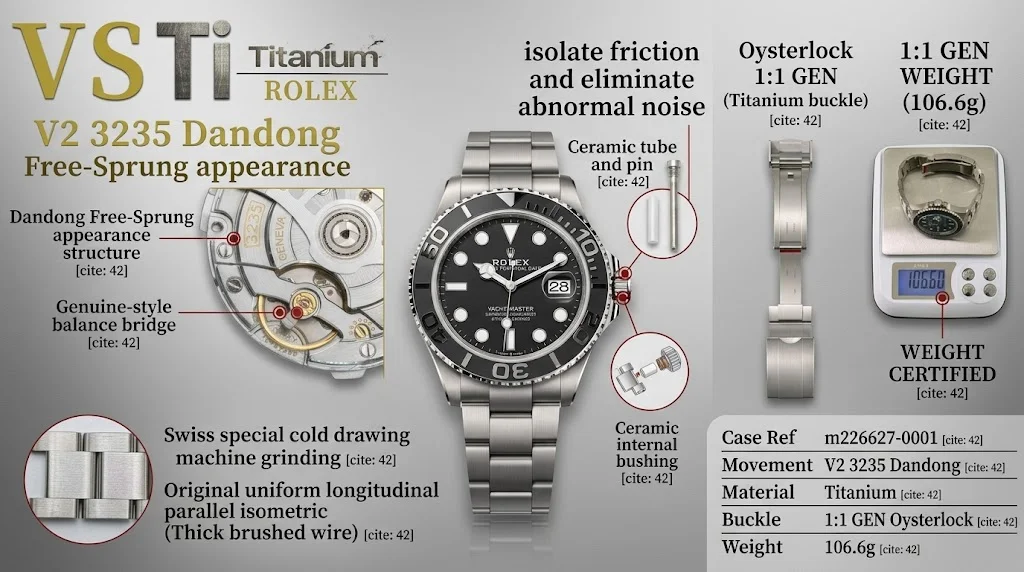
Titanium has been a headache for replica factories for years. It's harder to mill than steel, the brushing grain density is different, and hitting the right weight without making the case too thick is a real constraint. Most factories just skipped it and stuck with steel. VSF didn't.
The 2026 V2 update to their titanium Yacht-Master Ref. 226627-0001 addresses the three things that mattered most: the movement architecture, the case dimensions, and the bracelet construction. Here's what changed and why it matters.
Table of contents
Movement: Dandong 3235 V2 and the free-sprung fix
Dial: matte grey-black and pink AR coating
Case: 11.73mm and lug chamfering
Bracelet: coarse brushing and ceramic link tubes
Spec summary
1. Movement: Dandong 3235 V2 and the free-sprung fix
The biggest change in V2 is under the caseback. The original VSF Dandong 3235 already held a 72-hour power reserve, which was competitive. The problem was the regulator. Standard clone movements use a visible regulator arm to adjust the rate — it's an immediate tell under a loupe because gen Rolex calibers don't have one. They use a free-sprung balance with micro-adjustment weights on the balance wheel itself.
The V2 movement fixes this. VSF redesigned the balance assembly to simulate the free-sprung appearance. The regulator tail is gone, replaced by a bridge and weight system that looks correct at a glance. It's not a functional free-sprung balance — the adjustment mechanism is still conventional underneath — but visually, through the display caseback or under inspection, it reads as gen architecture. For a clone movement at this price point, that's about as far as anyone has taken it.
2. Dial: matte grey-black and pink AR coating
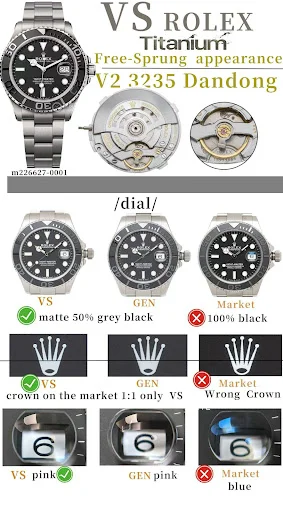
The dial on the gen 226627 is not pure black. It's a muted, matte grey-black that diffuses light evenly rather than reflecting it. Cheaper replicas use a glossy 100% black dial, which looks wrong under any light source other than total darkness. VSF matched the gen's matte 50% grey-black tone, and the difference is noticeable side by side with budget versions. No harsh reflections, no shininess.
Two other details worth flagging. The printed coronet at 12 o'clock has the correct spacing and crown curvature — a micro-detail that other factories tend to stretch or flatten. And the date cyclops has a pink AR coating, matching gen, instead of the blue AR tint that budget versions almost universally default to. Blue AR over the date window distorts the font color and stands out as wrong the moment you tilt the watch under a light.
3. Case: 11.73mm and lug chamfering
Titanium warps more easily than steel during machining, so hitting gen dimensions — particularly case thickness — requires tighter process control than a steel case. VSF got it to 11.73mm, verified by digital caliper. Gen is 11.73mm. Competitor titanium Yacht-Master cases typically come in at 12.33mm or thicker because they're using generic case blanks and thicker movements. That extra 0.6mm sounds like nothing on paper; on wrist, a Yacht-Master with a bloated mid-case reads wrong immediately.
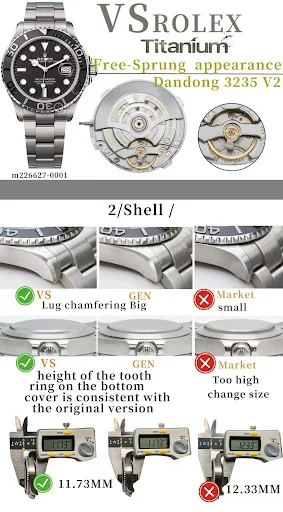
The caseback ring teeth match gen height and geometry — another thing competitors get wrong when they re-use tooling from steel models. And the lug chamfering is done on CNC, not hand-finished, so it's consistent across all four corners. The wider "big chamfer" profile matches current-gen Yacht-Master specs. Earlier rep versions used narrower, half-finished lug edges that were one of the easier ways to spot a clone from across a room.
4. Bracelet: coarse brushing and ceramic link tubes
Titanium feels different on skin than steel — warmer, less dense — and the brushing texture is part of that. Gen titanium Rolex bracelets use a coarse, longitudinal parallel brushing pattern. Most replicas apply the same fine, smooth brushing they use on their steel models, which misses the entire texture of the watch.
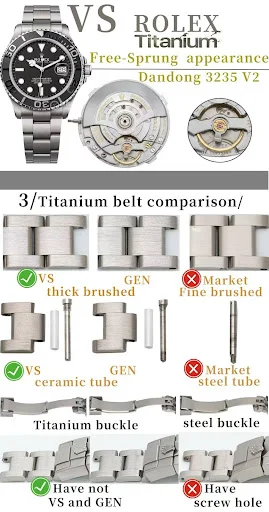
VSF used Swiss cold-pulling tools to apply a directional coarse brush across the case and bracelet links. The grain is visibly thicker and more directional than what you see on standard steel reps, and it matches the matte, utilitarian look of gen titanium. It won't be to everyone's taste — titanium doesn't shine the way steel does — but it's accurate to gen.
The hidden upgrade is the陶瓷 tubes inside the bracelet links. The connecting rods between links are sleeved in ceramic instead of steel. On cheaper bracelets, steel-on-steel contact at these connection points creates friction, which produces an audible squeak when the bracelet flexes. Over time it gets worse as the metal wears. Ceramic sleeves eliminate the noise and keep the articulation smooth. It's the kind of thing nobody talks about because nobody sees it, but you hear it every time you put the watch on or take it off.
The whole bracelet and clasp are titanium, including the deployant. Total weight is 106.6 grams — light for a 42mm sports watch, which is the point. Steel versions of this reference run heavier and show discoloration at the link edges over time, especially on polished surfaces.
5. Spec summary
| Parameter | VSF V2 | Standard competitors |
|---|---|---|
| Movement | Dandong 3235 V2 (simulated free-sprung, 72h) | Standard clone with regulator tail, short reserve |
| Case thickness | 11.73mm (1:1) | 12.33mm+ (bloated) |
| Brushing | Longitudinal coarse parallel brush | Fine smooth brush (wrong texture) |
| Link connectors | Ceramic tubes (friction isolated) | Steel tubes (squeak over time) |
| Dial/optics | Matte 50% grey-black, pink AR cyclops | Glossy 100% black, blue AR cyclops |
Bottom line: The V2 update is primarily a movement story — the free-sprung appearance mod is the headline change, and it closes one of the biggest visual gaps between clones and gen. But the case dimensions, the ceramic link tubes, and the dial color correction would each be worth mentioning on their own. VSF put the work into the things you see first (the dial, the case profile) and the things you live with over time (the bracelet noise, the movement tells). It's the best titanium Yacht-Master replica available right now. The main question is whether you're willing to deal with titanium's quirks — the lighter weight, the softer brushing, the fact that it scratches differently than steel. It's a different wearing experience, and that's the point.