

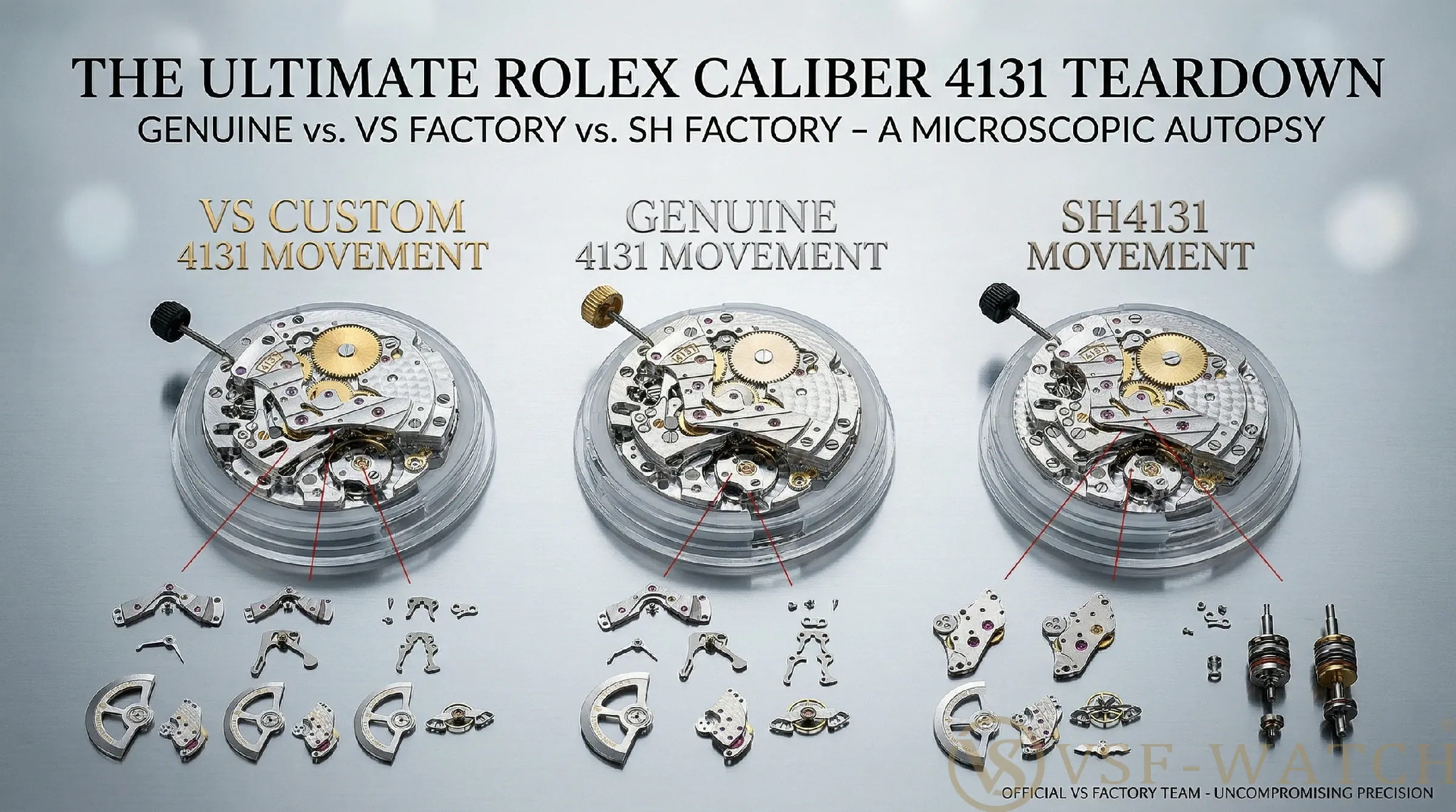
The Daytona's move from the 4130 to the 4131 caliber wasn't just a rotor redesign. Rolex added Côtes de Geneve decoration, skeletonized the winding weight, and refined the escapement. The clone market followed immediately, and two versions emerged: VSF's custom 4131 and the SH Factory 4131. They look similar through a display case back. They are not similar underneath.
This teardown puts all three movements side by side — gen, VSF, and SH — across the areas that matter for reliability and accuracy.
1. Front plate finishing
The front mainplate sits under the dial, where nobody sees it after assembly. It's a good indicator of overall machining quality because factories that cut corners here cut corners everywhere.
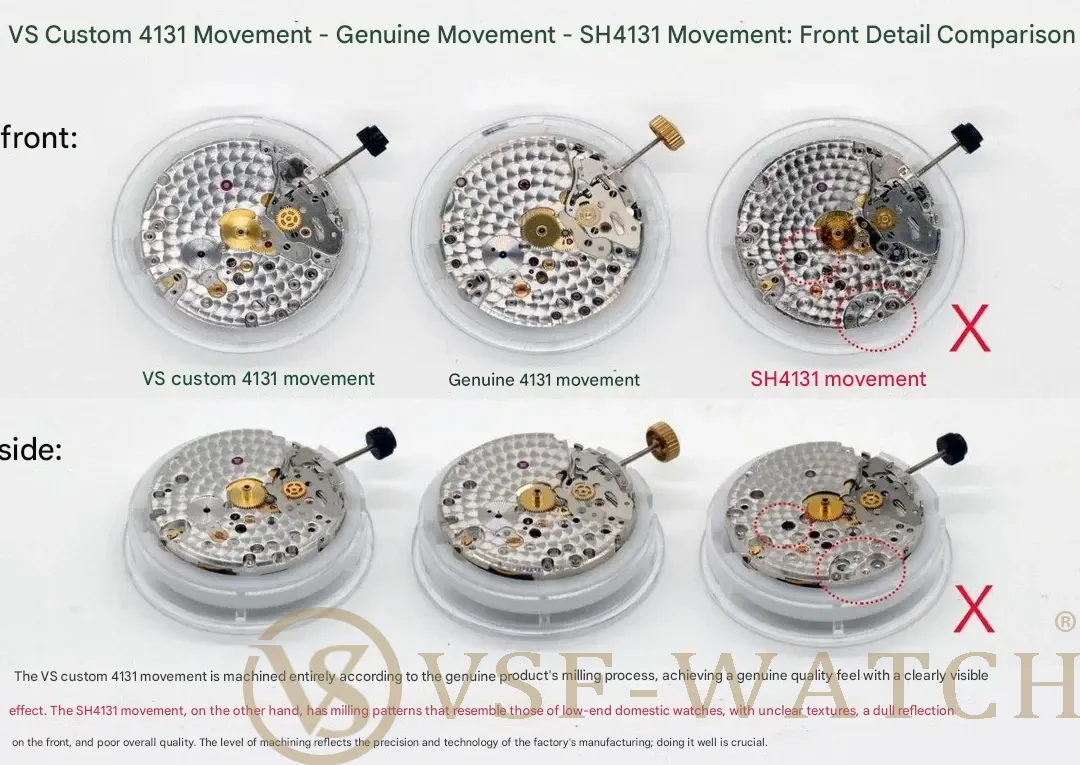
Gen 4131: sharp, even perlage with consistent micron-level depth across every overlapping circle. Clean metallic reflection.
VSF 4131: near-identical perlage and luster. The pattern depth and light refraction match gen. Five-axis CNC work, not stamped or etched.
SH 4131: blurry circular patterns with no depth. Instead of a bright metallic reflection, the surface reads as dull and dark. The base metal is lower grade and the polishing is crude.
2. Jewel bearings: the transmission shaft
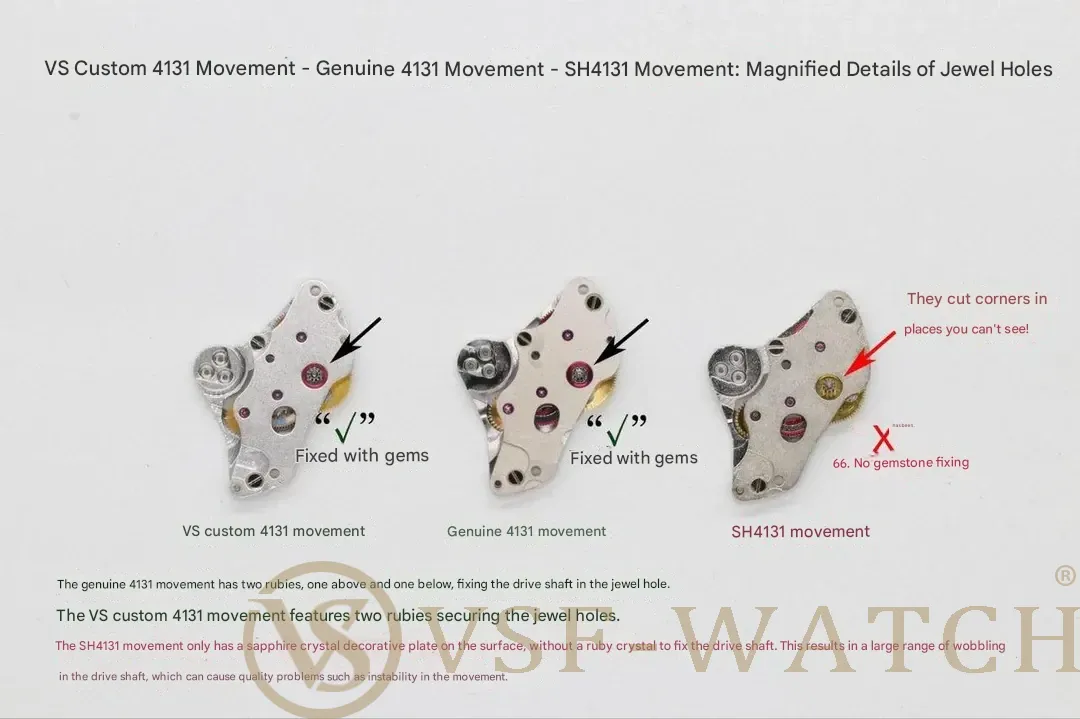
The main transmission shaft needs ruby bearings on both ends to stay aligned under load. If either bearing is missing, the shaft wobbles.
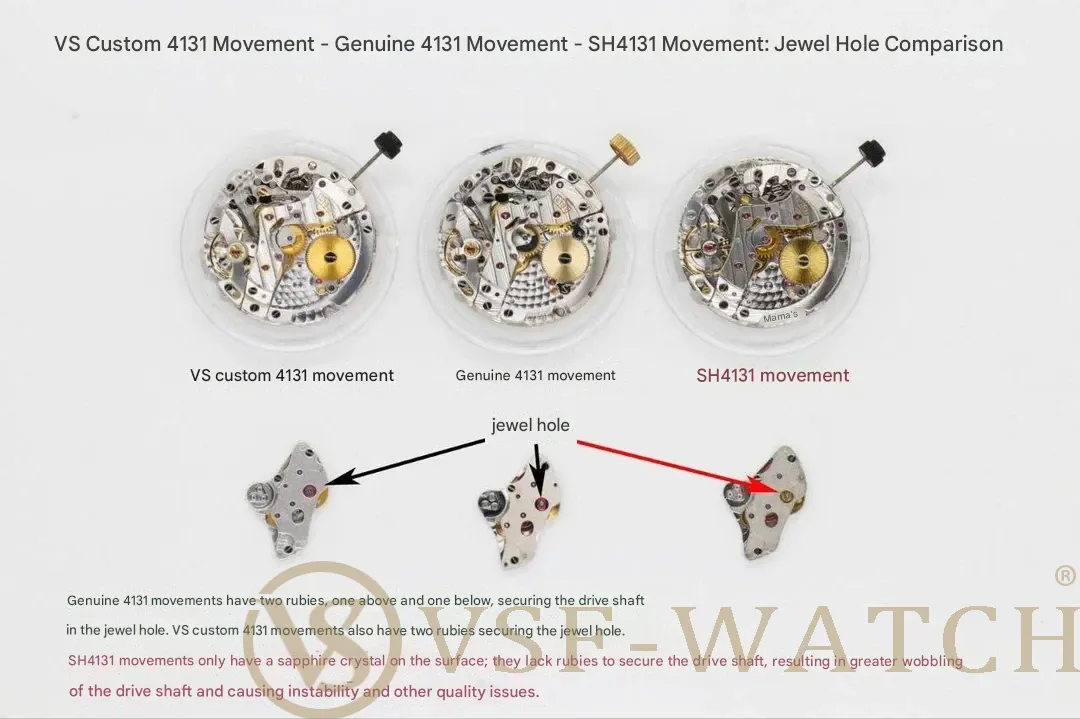
Gen 4131: functional Ruby on top, functional Ruby on the bottom. The shaft is fully supported.
VSF 4131: same dual-ruby setup. Both rubies are functional, not decorative.
SH 4131: blue sapphire cap glued to the top surface for appearance. No ruby bearing on the bottom. The transmission shaft has no lower support, which means lateral wobble during operation, increased friction, erratic power delivery, and eventual failure. This is the kind of corner-cutting that doesn't show up in QC photos but destroys the movement over months of wear.
3. Under the rotor
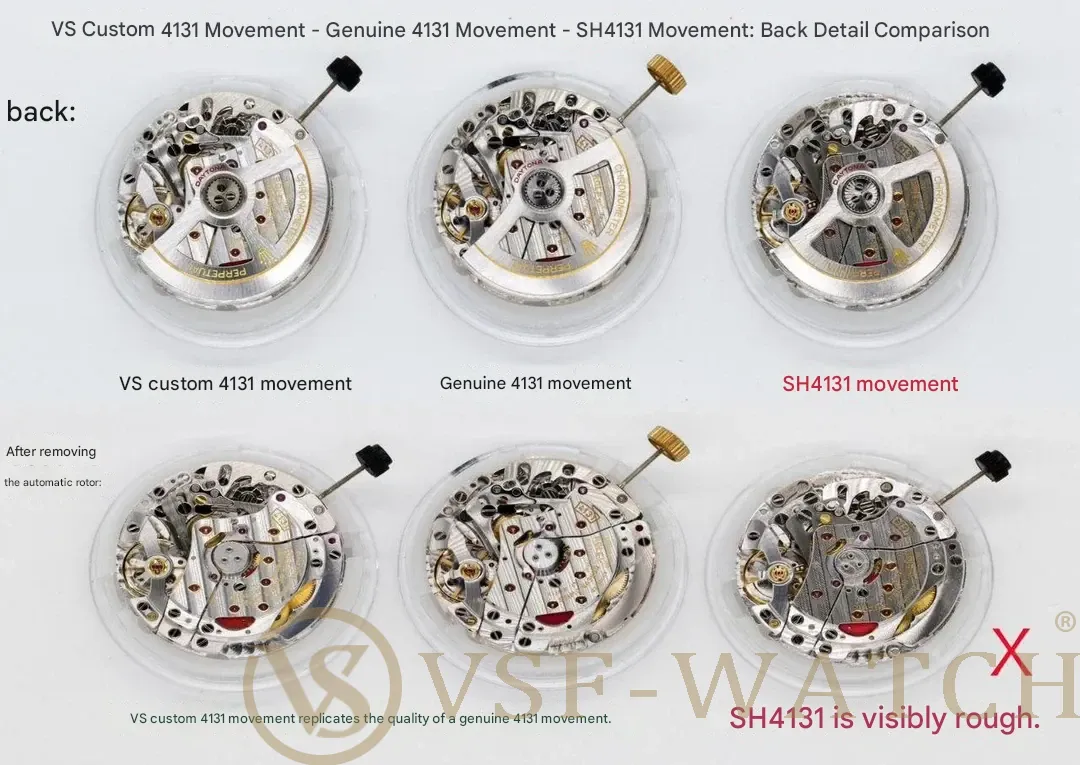
Rotor removed:
Gen 4131: clean Geneva stripes, polished screw heads, chamfered bridge edges, rhodium plating.
VSF 4131: same standard of finishing. Radial brushing is consistent, screw heads are polished, and bridge edges are chamfered. The bridges are the correct architecture, not cosmetic overlays.
SH 4131: rough plates, no refined brushing, sharp unfinished edges. Reads as cheap even without magnification.
4. Escapement limiting plate ("horseshoe")
Under the balance wheel, a small limiting plate (watchmakers call it the horseshoe) controls how far the pallet fork can travel. The shape determines the escapement's operating angles.
Gen 4131: gourd-shaped plate, mathematically profiled for the correct limiting angle.
VSF 4131: identical gourd-shaped geometry. Same tolerances as gen.
SH 4131: wrong shape entirely. Because the plate can't perform the limiting function on its own, SH has to add a workaround — see section 6.
5. Pallet fork geometry
The pallet fork transfers energy from the gear train to the balance wheel. Its weight and shape directly affect amplitude stability.
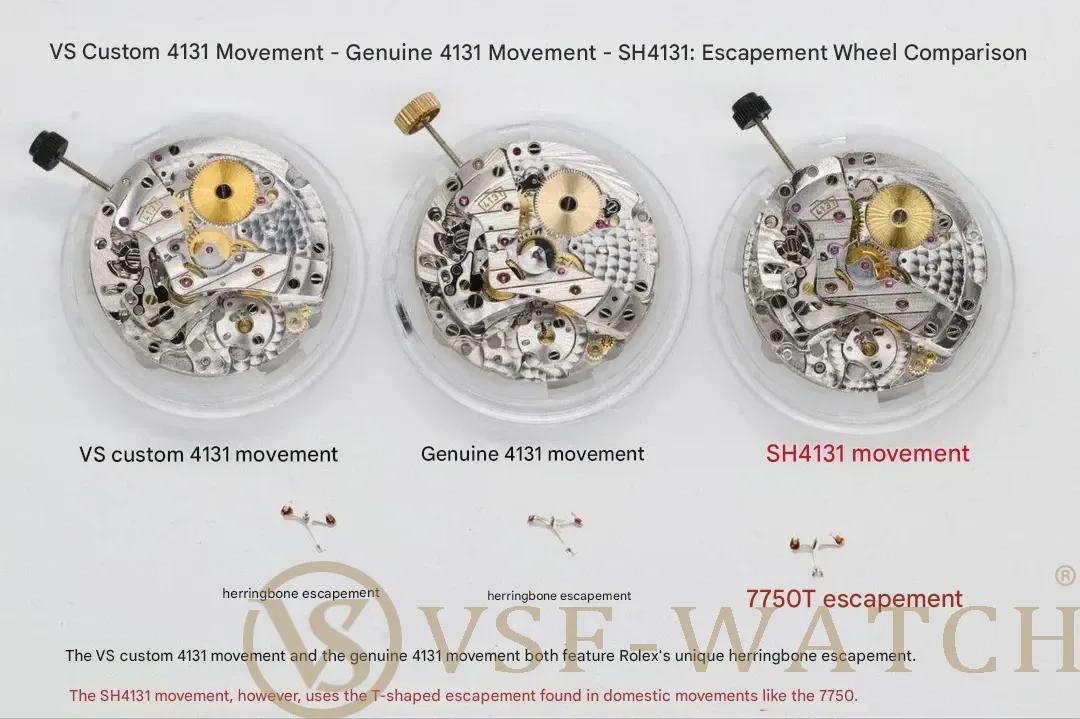
Gen 4131: skeletonized "wishbone" fork. Lightweight, low inertia, fast energy transfer.
VSF 4131: same skeletonized wishbone design. Correct mass, correct geometry.
SH 4131: solid T-shaped fork from a generic chronograph movement (functionally equivalent to what you'd find in an Asian 7750). Heavier, higher inertia, more energy loss per tick. This is the wrong component for a 4131 clone and directly affects timekeeping.
6. Extra banking pins (SH only)
Because SH used the wrong pallet fork and the wrong limiting plate, the escapement physically cannot run without additional mechanical stops. Under the balance wheel of the SH 4131, there are two extra brass banking pins drilled into the baseplate. Their only job is to forcibly limit the travel of the incorrect pallet fork.
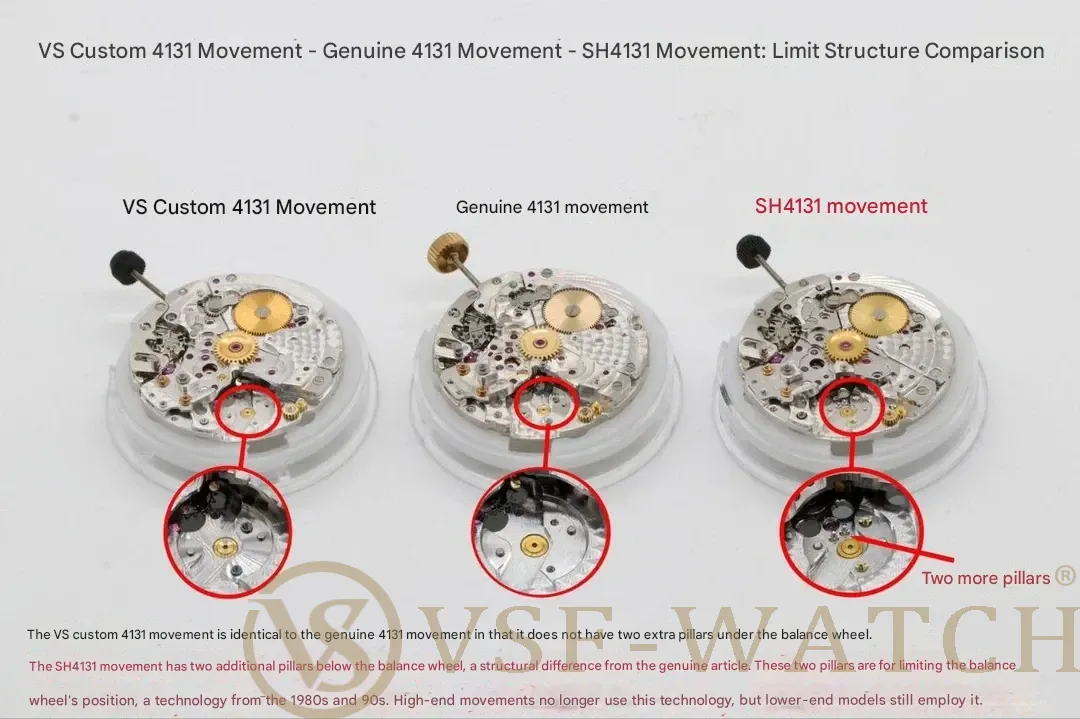
This is 1980s-level engineering. Modern movements do not use upright brass pins in the escapement — they use integrated limiting geometry like the gourd-shaped horseshoe. Gen and VSF have zero extra pins under the balance wheel. The SH pins are visible through the caseback if you know where to look.
7. Shock absorption and regulation
Gen 4131: functional Paraflex shock absorbers at key pivots. Free-sprung balance — no regulator arm, timekeeping adjusted via Microstella weights on the balance wheel.
VSF 4131: functional shock absorbers, not cosmetic covers. True free-sprung balance with working adjustment weights. The shock system actually absorbs impact rather than just looking like it does.
SH 4131: decorative shock absorber bridge glued over a standard, cheap shock setting. Fake free-sprung system — the adjustment weights on the balance wheel are cosmetic only, and a hidden traditional regulator arm does the actual timing. A hard knock will throw the SH movement out of regulation or snap the balance staff.
8. Full teardown
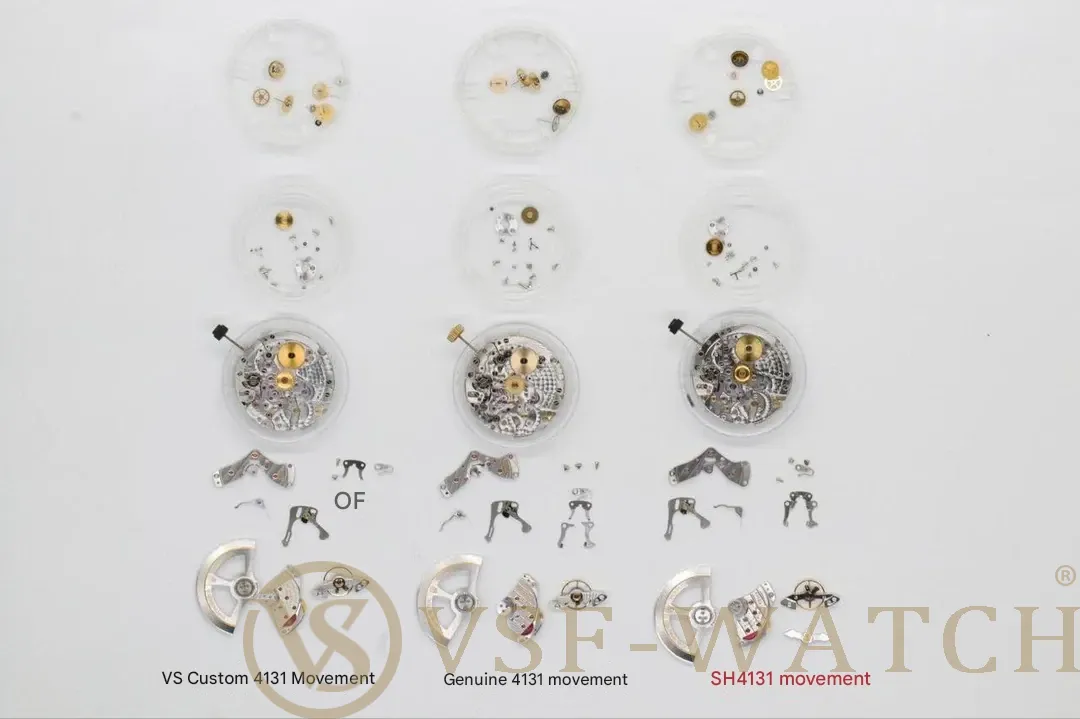
All three movements fully disassembled, components laid out side by side:
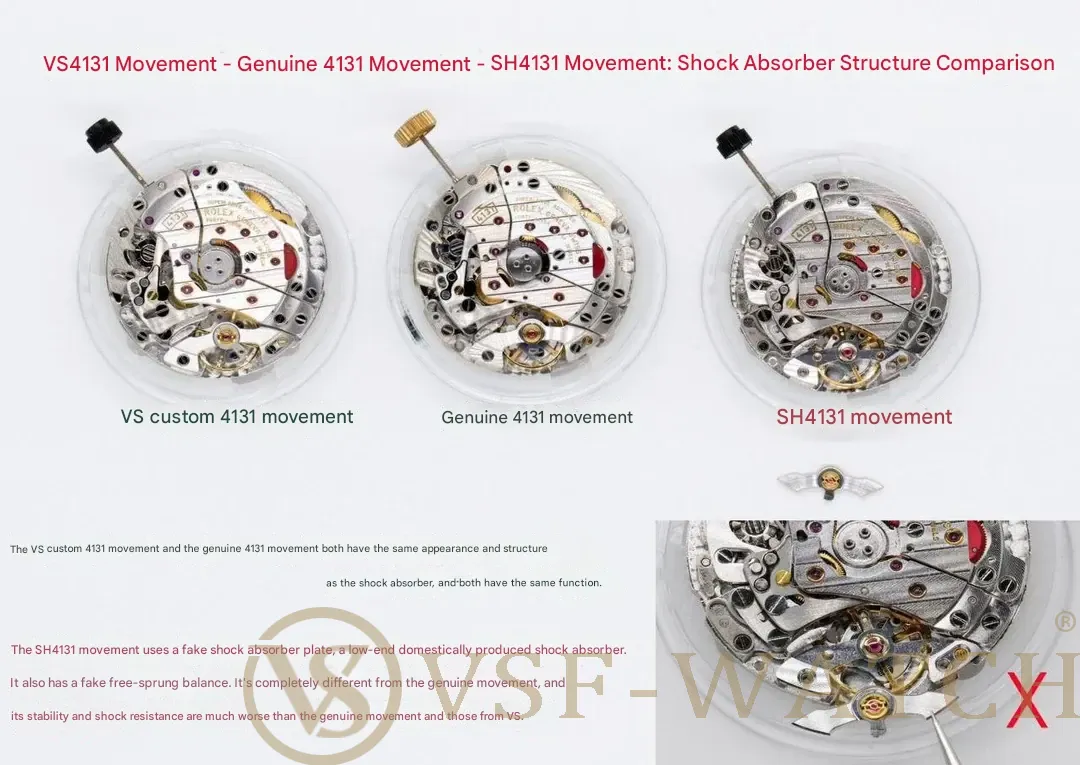
Gen and VSF: gears, mainspring barrel, escapement, bridges, and screws match part for part. The VSF is a structural clone.
SH: mismatched parts once the decorative plates come off. Wrong pallet fork, extra banking pins, fake shock bridges. It's a generic chronograph movement in a 4131 case.
| Feature | Gen 4131 | VSF 4131 | SH 4131 |
|---|---|---|---|
| Front plate finish | Sharp perlage, bright metallic luster | Identical perlage and luster | Blurry, dark matte reflection |
| Transmission jewels | Functional upper and lower rubies | Functional upper and lower rubies | Fake surface cap, no lower ruby |
| Pallet fork | Skeletonized wishbone | Skeletonized wishbone | Solid T-shape (7750-style) |
| Escapement limiting | Gourd-shaped plate | Gourd-shaped plate | Wrong shape + extra banking pins |
| Shock absorber | Functional Paraflex | Functional shock unit | Glued-on fake bridge |
| Regulation | True free-sprung | True free-sprung | Fake weights, hidden regulator arm |
Bottom line: The SH 4131 uses the same playbook as budget clone movements always have: make the visible parts look right, cut everything underneath. Fake rubies, fake shock absorbers, wrong pallet fork geometry, and extra banking pins holding the escapement together. It looks fine through a display case back for about three seconds. It does not hold up to use.
The VSF 4131 is a structural clone. The parts that matter for reliability — the jewel bearings, the pallet fork, the shock system, the free-sprung balance — are functional, not decorative. If you're buying a 4131-based Daytona and you care about the movement being correct rather than just looking correct, the SH version is not a cheaper alternative. It's a different product entirely.
The usual caveat: the VSF 4131 is still a clone movement. Serviceability requires a watchmaker who knows the caliber. Parts are not as widely available as ETA-based movements. Factor that in.
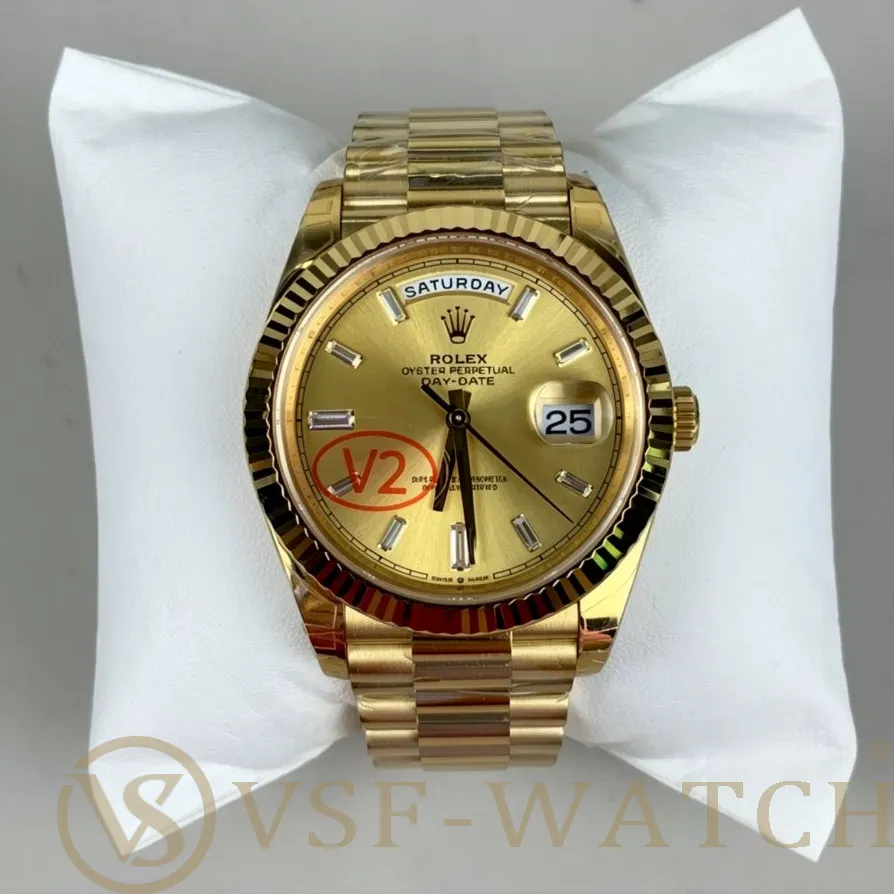 VS Factory DDV2 Weighted Version Build Quality Revealed: 182
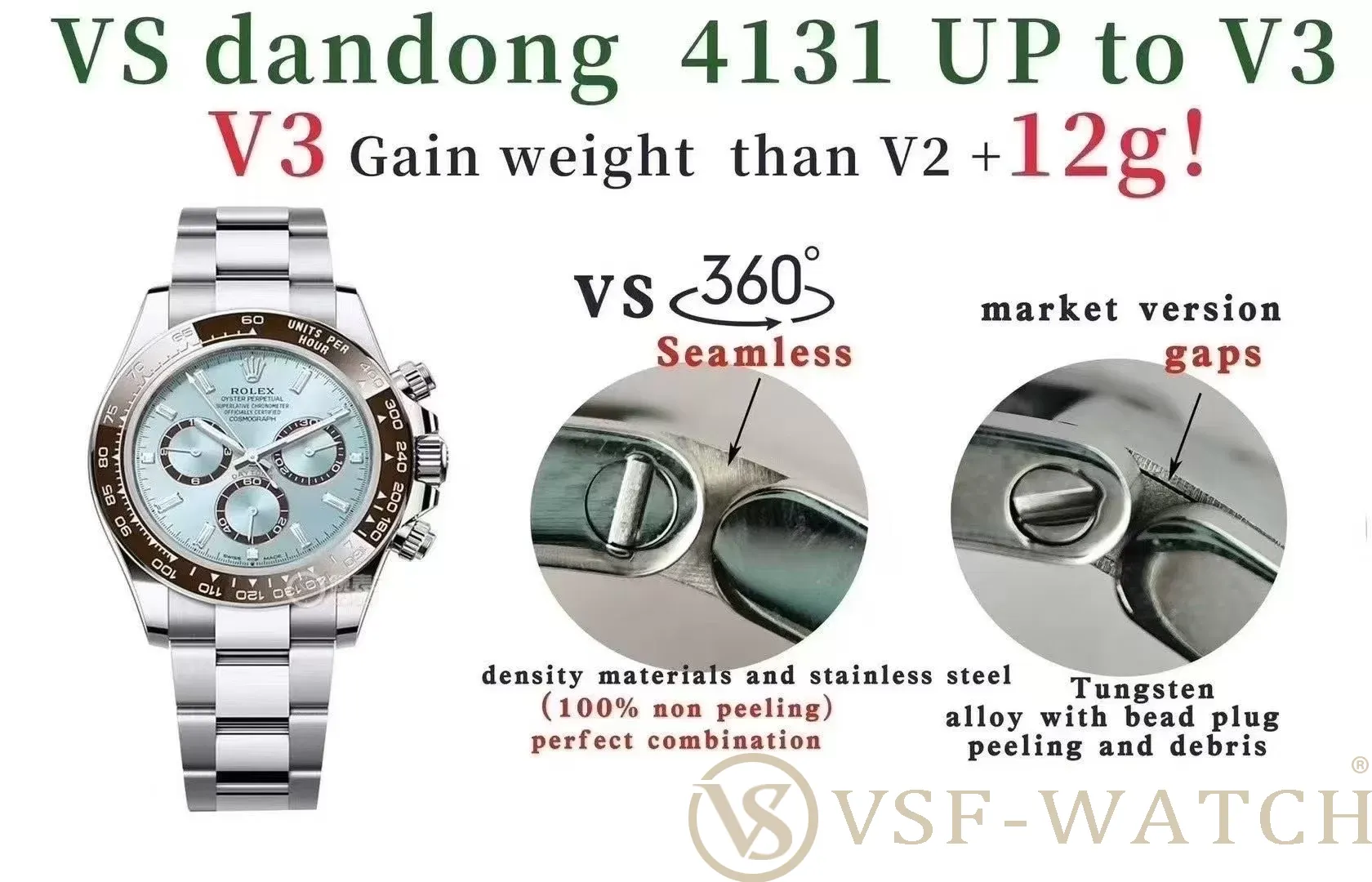 VSF Watch Rolex Daytona "Ice Blue" Platinum V3: 17
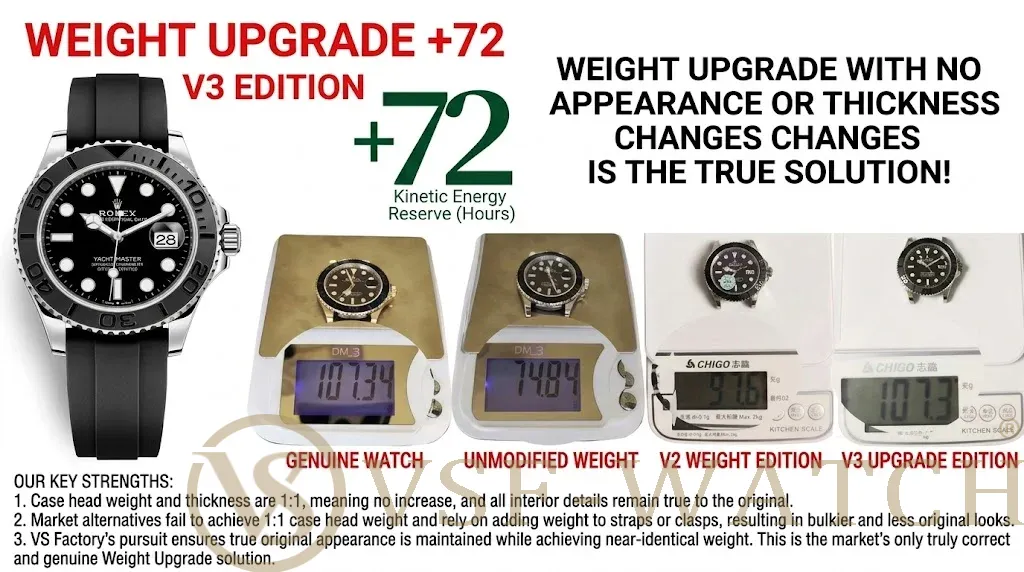 VSF Watch Rolex Yacht-Master 42mm (226659): VS3235 Movement
 VSF Watch Rolex Datejust 41mm Silver Dial Review